


My core experience is Delta through Databricks and OSS which I have mostly used and covered as well in previous articles, I love it and its great, but to really have a more seamless experience in AWS environment, Delta is not the first class citizen, AWS have focused on Iceberg since the launch of S3 Tables few years ago.
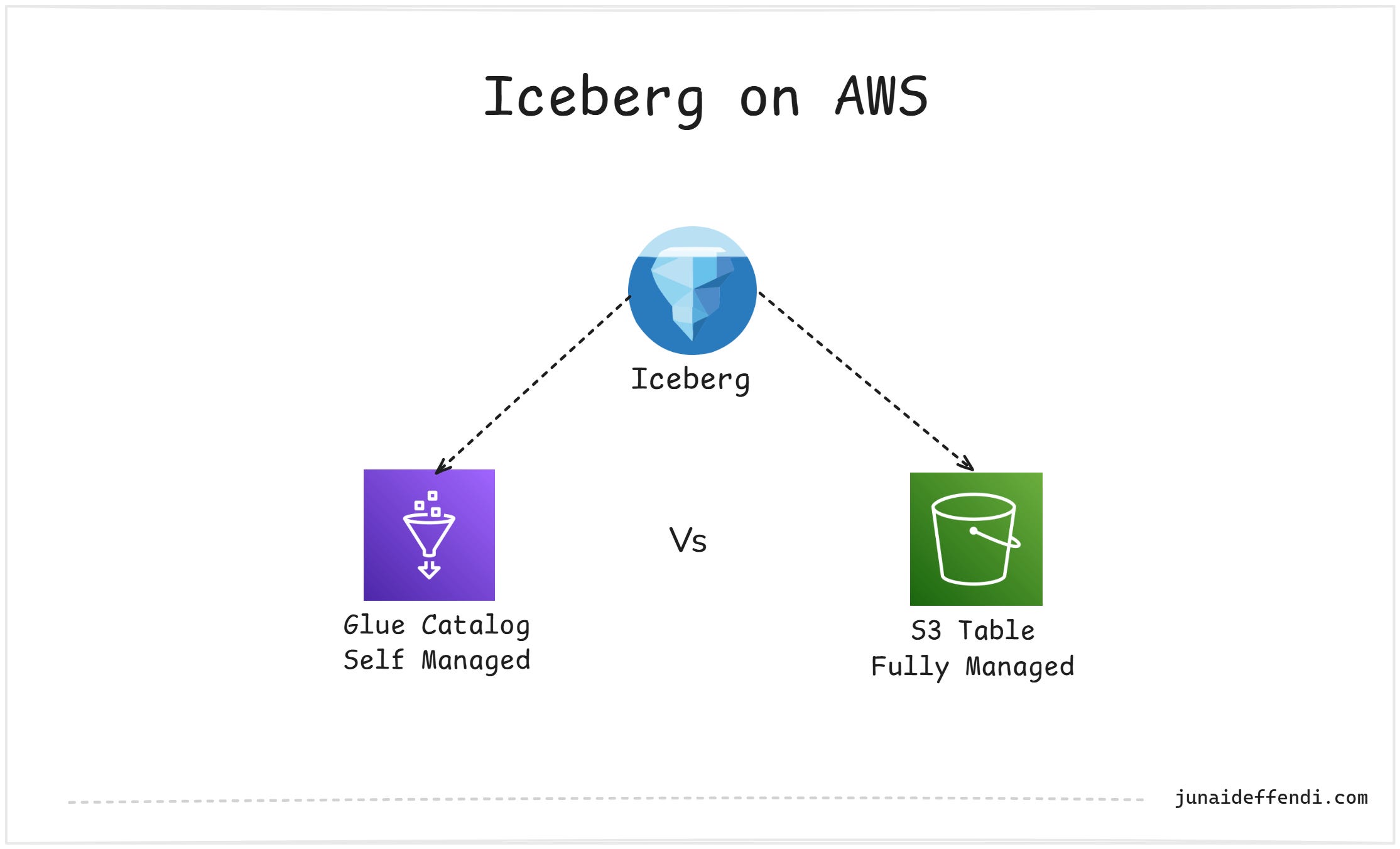
The goal of this article is to help you when deciding between Iceberg via Glue Catalog or fully managed Iceberg via S3 Tables. But first you should be on AWS and you should have the knowledge of the tech stack being used.
Why This Decision Is Harder Than It Looks
On the surface, S3 Tables and Glue-backed Iceberg look identical. Both are Iceberg, both store data on S3, both handle compaction and snapshot management. So when AWS introduced S3 Tables, the natural reaction was “isn’t that just... Iceberg?” Almost. The difference isn’t in the format, it’s in what sits around it: the catalog layer, the integration surface, and how much of the operational stack AWS owns versus you.
Setup
Neither approach is zero-effort, both require provisioning AWS resources before you write your first table. The difference is what you’re managing, not how much.
Glue-backed Iceberg
S3 bucket (and KMS key if encryption is required)
Glue Catalog database
Table optimizer enabled on the Glue Catalog (one-off configuration)
S3 Tables
S3 Tables Bucket (and KMS key if encryption is required)
S3 Tables Namespace (equivalent of a Glue database)
S3 Tables Catalog is created automatically
The practical difference is that S3 Tables abstracts away the underlying S3 complexity. You never deal with bucket paths, prefixes, or storage layout directly. With Glue-backed Iceberg, that structure is yours to manage, which is also what gives you direct access to it.
Read, write, and Lake Formation: Once set up, both approaches behave identically at query time. Read and write operations work the same way, Lake Formation permissions apply to both, and S3 Tables is simply treated as a different catalog. Your queries change only in the table path, not in structure or syntax.
Iceberg version: Both run the same Apache Iceberg format. The version in use is determined by your compute layer; the EMR release or Glue version you’re running, not by which catalog approach you chose. Feature parity between the two is not a factor in this decision.
The Core Tradeoffs
Third-party integrations
If your stack includes Snowflake, Databricks, dbt, or anything outside AWS-native, use Iceberg via Glue Catalog. Glue Catalog is the lingua franca of the AWS data ecosystem, federation is production-ready today, and Multi Dialect Views work seamlessly. S3 Tables has limited third-party support and does not support Multi Dialect Views as of this writing.
Terraform
If Terraform is a hard requirement, use Iceberg via Glue Catalog Iceberg. Full coverage exists for Glue databases, tables, crawlers, and Lake Formation permissions with no surprises at deploy time. S3 Tables Terraform support is immature enough to be a blocker.
Existing Glue investment
If your team is already using Glue in any form; crawlers, catalog, Lake Formation, extending it to Iceberg is the lower-effort path. There is no reason to take on the learning curve of S3 Tables when the infrastructure is already in place.
Metadata access and observability
If your team needs direct access to S3 paths, manifest inspection, or snapshot introspection for debugging or custom tooling, use Glue-backed Iceberg. S3 Tables abstracts storage away by design, which is a feature for some teams and a limitation for others.
Team size and operational overhead
If you have a small team, a high table count, or want zero storage operations burden, S3 Tables is worth considering. It handles the S3 complexity for you, which is a real advantage for platform teams building self-serve layers where consumers should never touch storage.
Greenfield AWS-native setup
If you are starting fresh with a fully AWS-native stack (Athena, EMR) and have no third-party integration needs, S3 Tables is a reasonable default. The operational simplicity is genuine, and you avoid taking on Glue infrastructure you may not need.
Decision Flow
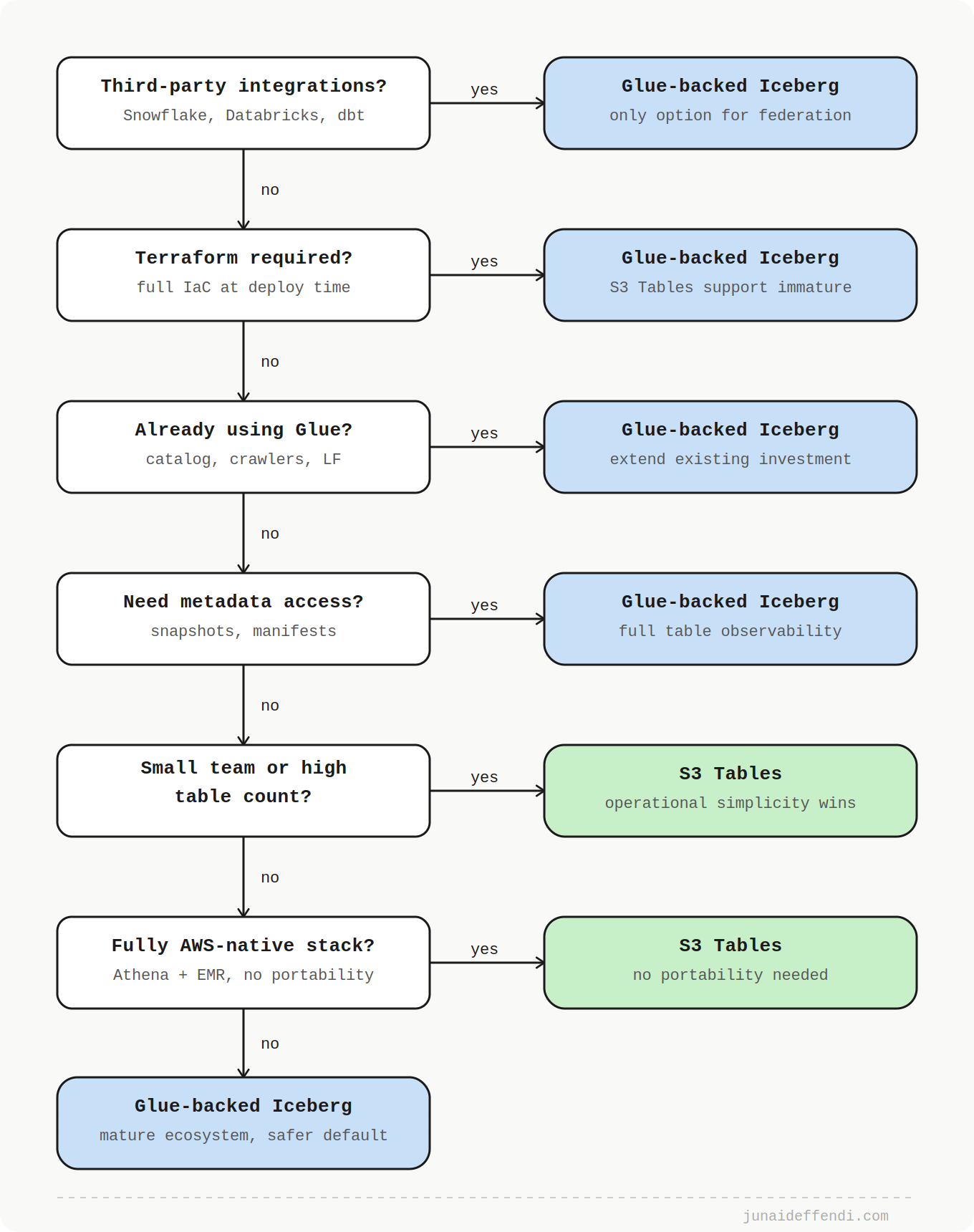
In most cases, Glue-backed Iceberg is the safer choice. It is the more mature ecosystem with fewer bugs, fewer limitations, and a broader integration surface. The decision is entirely about operational model and ecosystem fit.

